Equipping a vector space with an inner product results in a natural isomorphism VV\CV\to\CV^\ast, where the metric tensor can be interpreted as the linear mapping g:VV\Bg:\CV\to\CV^\ast and its inverse g1:VV\Bg\inv:\CV^\ast\to\CV.

Notation: Given two real vector spaces V\CV and W\CW, we denote their inner products as  ⁣, ⁣V\dabrn{\cdot,\cdot}_{\CV} and  ⁣, ⁣W\dabrn{\cdot,\cdot}_{\CW} respectively. Given vectors vV\Bv\in\CV and wW\Bw\in\CW, we define their lengths as

vV= ⁣v,v ⁣VandwW= ⁣w,w ⁣W.\begin{equation} \Norm{\Bv}_{\CV} = \sqrt{\dabrn{\Bv,\Bv}_{\CV}} \eqand \Norm{\Bw}_{\CW} = \sqrt{\dabrn{\Bw,\Bw}_{\CW}}. \tag{1}\end{equation}

Regarding V\CV and W\CW,

  1. their bases are denoted {EA}\cbrn{\BE_A} and {ea}\cbrn{\Be_a},
  2. their dual bases are denoted {EA}\cbrn{\BE^A} and {ea}\cbrn{\Be^a},
  3. their metrics are denoted G\BG and g\Bg with the components GAB= ⁣EA,EB ⁣VG_{AB}=\dabrn{\BE_A,\BE_B}_{\CV} and gab= ⁣ea,eb ⁣Wg_{ab}=\dabrn{\Be_a,\Be_b}_{\CW},

respectively. Here, the indices pertaining to V\CV are uppercase (ABC)(ABC\dots) and the indices pertaining to W\CW are lowercase (abc)(abc\dots).

Definition: Let P:VW\BP:\CV\to\CW be a linear mapping. Then the transpose, or adjoint of P\BP, written PT\BP\tra, is the linear mapping

PT:WVsuch that ⁣v,PTw ⁣V= ⁣Pv,w ⁣W\begin{equation} \boxed{ \BP\tra: \CW\to\CV \quad\text{such that}\quad \dabrn{\Bv,\BP\tra\Bw}_{\CV} = \dabrn{\BP\Bv,\Bw}_{\CW} } \tag{2}\end{equation}

for all vV\Bv\in\CV and wW\Bw\in\CW. Carrying out the products,

GBAvB(PT)Adwd=gabPbCvCwa.\begin{equation} G_{BA} v^B (P\tra){}^{A}{}_{d} w^d = g_{ab} P{}^{b}{}_{C}v^Cw^a. \tag{3}\end{equation}

For arbitrary v\Bv and w\Bw,

GBA(PT)Aa=gabPbA\begin{equation} G_{BA} (P\tra){}^{A}{}_{a} = g_{ab} P{}^{b}{}_{A} \tag{4}\end{equation}

from which we can obtain the components of the transpose as

(PT)Aa=gabPbBGABandPT=(PT)AaEAea.\begin{equation} \boxed{ (P\tra){}^{A}{}_{a} = g_{ab} P{}^{b}{}_{B} G^{AB} \eqwith \BP\tra = (P\tra){}^{A}{}_{a} \BE_A\dyd\Be^a . } \tag{5}\end{equation}

If B:VV\BB:\CV\to\CV is a linear mapping, it is called symmetric if B=BT\BB=\BB\tra.

Definition: Let P:VW\BP:\CV\to\CW be a linear mapping. Then the dual of P\BP is a metric independent mapping

P:WVsuch thatv,PβV=Pv,βW\begin{equation} \boxed{ \BP^\ast: \CW^\ast\to\CV^\ast \quad\text{such that}\quad \abrn{\Bv,\BP^\ast\Bbeta}_{\CV} = \abrn{\BP\Bv,\Bbeta}_{\CW} } \tag{6}\end{equation}

defined through natural pairings for all vV\Bv\in\CV and βW\Bbeta\in\CW^\ast. Carrying out the products,

vA(P)Aaβa=PbBvBβb.\begin{equation} v^A (P^\ast){}_{A}{}^{a} \beta_a = P{}^{b}{}_{B} v^B \beta_b. \tag{7}\end{equation}

For arbitrary v\Bv and β\Bbeta, we obtain the components of the dual mapping as

(P)Aa=PaAandP=(P)AaEAea=PaAEAea.\begin{equation} \boxed{ (P^\ast){}_{A}{}^{a} = P{}^{a}{}_{A} \eqwith \BP^\ast = (P^\ast){}_{A}{}^{a} \BE^A\dyd\Be_a = P{}^{a}{}_{A} \BE^A\dyd\Be_a . } \tag{8}\end{equation}

To fully appreciate the symmetry that originates from the duality, we can think of not just the mappings between V\CV and W\CW, but also between their dual spaces. To this end we can enumerate four mappings corresponding to {V,V}{W,W}\cbr{\CV,\CV^\ast}\to\cbr{\CW,\CW^\ast} and their duals, corresponding to {W,W}{V,V}\cbr{\CW,\CW^\ast}\to\cbr{\CV,\CV^\ast}. Their definitions can be found in the table below.

Mappings
PWV\BP\in\CW \dyd\CV^\ast

PAa=P(ea,EA)P^a_{\idxsep A}=\BP(\Be^a,\BE_A)
P=PAaeaEA\BP = P^{a}_{\idxsep A}\, \Be_a \dyd \BE^A
QWV\BQ\in\CW^\ast \dyd\CV^\ast

QaA=Q(ea,EA)Q_{aA}=\BQ(\Be_a,\BE_A)
Q=QaAeaEA\BQ = Q_{aA}\, \Be^a \dyd \BE^A
RWV\BR\in\CW \dyd\CV

RaA=R(ea,EA)R^{aA}=\BR(\Be^a,\BE^A)
R=RaAeaEA\BR = R^{aA}\, \Be_a \dyd \BE_A
SWV\BS\in\CW^\ast \dyd\CV

SaA=S(ea,EA)S_a^{\idxsep A}=\BS(\Be_a,\BE^A)
S=SaAeaEA\BS = S_{a}^{\idxsep A}\, \Be^a \dyd \BE_A
P:VW\BP: \CV \to \CW

vP(ea,v)ea=PvvAEAPAavAea\begin{aligned} \Bv &\mapsto \BP(\Be^a,\Bv) \Be_a \\ &= \BP\Bv \\ v^A\BE_A &\mapsto P^a_{\idxsep A} v^A \Be_a \end{aligned}
Q:VW\BQ: \CV \to \CW^\ast

vQ(ea,v)ea=QvvAEAQaAvAea\begin{aligned} \Bv &\mapsto \BQ(\Be_a,\Bv) \Be^a \\ &= \BQ\Bv \\ v^A\BE_A &\mapsto Q_{aA} v^A \Be^a \end{aligned}
R:VW\BR: \CV^\ast \to \CW

αR(ea,α)ea=RαTαAEARaAαAea\begin{aligned} \Balpha &\mapsto \BR(\Be^a,\Balpha) \Be_a \\ &= \BR\Balpha\tra \\ \alpha_A \BE^A &\mapsto R^{aA} \alpha_A \Be_a \end{aligned}
S:VW\BS: \CV^\ast \to \CW^\ast

αS(ea,α)ea=SαTαAEASaAαAea\begin{aligned} \Balpha &\mapsto \BS(\Be_a,\Balpha) \Be^a \\ &= \BS\Balpha\tra \\ \alpha_A \BE^A &\mapsto S_a^{\idxsep A} \alpha_A \Be^a \end{aligned}
P:W×VR\BP: \CW^\ast \times \CV \to \IR

(β,v)P(β,v)=βPv=βaPAavA\begin{aligned} (\Bbeta,\Bv) &\mapsto \BP(\Bbeta,\Bv) \\ &=\Bbeta\BP\Bv \\ &= \beta_a P^{a}_{\idxsep A} v^A \end{aligned}
Q:W×VR\BQ: \CW \times \CV \to \IR

(w,v)Q(w,v)=wTQv=waQaAvA\begin{aligned} (\Bw,\Bv) &\mapsto \BQ(\Bw,\Bv) \\ &= \Bw\tra\BQ\Bv \\ &= w^a Q_{aA} v^A \end{aligned}
R:W×VR\BR: \CW^\ast \times \CV^\ast \to \IR

(β,α)R(β,α)=βRαT=βaRaAαA\begin{aligned} (\Bbeta,\Balpha) &\mapsto \BR(\Bbeta,\Balpha) \\ &= \Bbeta\BR\Balpha\tra \\ &= \beta_a R^{aA} \alpha_A \end{aligned}
S:W×VR\BS: \CW \times \CV^\ast \to \IR

(w,α)S(w,α)=wTSαT=waSaAαA\begin{aligned} (\Bw,\Balpha) &\mapsto \BS(\Bw,\Balpha) \\ &= \Bw\tra\BS\Balpha\tra \\ &= w^a S_a^{\idxsep A} \alpha_A \end{aligned}
Duals
PVW\BP^\ast\in \CV^\ast \dyd\CW

PAa=P(EA,ea)P^{\ast \, a}_A=\BP^\ast(\BE_A,\Be^a)
P=PAaEAea\BP^\ast = P^{\ast \, a}_A \, \BE^A \dyd \Be_a
QVW\BQ^\ast\in \CV^\ast \dyd\CW^\ast

QAa=Q(EA,ea)Q^\ast_{Aa}=\BQ^\ast(\BE_A,\Be_a)
Q=QAaEAea\BQ^\ast = Q^\ast_{Aa}\, \BE^A \dyd \Be^a
RVW\BR^\ast\in\CV \dyd \CW

RAa=R(EA,ea)R^{\ast Aa}=\BR^\ast(\BE^A,\Be^a)
R=RAaEAea\BR^\ast = R^{\ast Aa}\, \BE_A \dyd \Be_a
SVW\BS^\ast\in\CV \dyd\CW^\ast

SAa=S(EA,ea)S^{\ast A}{}_{a}=\BS^\ast(\BE^A,\Be_a)
S=SAaEAea\BS^\ast = S^{\ast A}{}_{a}\, \BE_A \dyd \Be^a
P:WV\BP^\ast: \CW^\ast \to \CV^\ast

βP(EA,β)EA=PβTβaeaPAaβaEA\begin{aligned} \Bbeta &\mapsto \BP^\ast(\BE_A,\Bbeta) \BE^A \\ &= \BP^\ast\Bbeta\tra \\ \beta_a\Be^a &\mapsto P^{\ast \, a}_A \beta_a \BE^A \end{aligned}
Q:WV\BQ^\ast: \CW \to\CV^\ast

wQ(EA,w)EA=QwwaeaQAawaEA\begin{aligned} \Bw &\mapsto \BQ^\ast(\BE_A,\Bw) \BE^A \\ &= \BQ^\ast\Bw \\ w^a\Be_a &\mapsto Q^\ast_{Aa} w^a \BE^A \end{aligned}
R:WV\BR^\ast: \CW^\ast \to \CV

βR(EA,β)EA=RβTβaeaRAawaEA\begin{aligned} \Bbeta &\mapsto \BR^\ast(\BE^A,\Bbeta) \BE_A \\ &= \BR^\ast\Bbeta\tra \\ \beta_a\Be^a &\mapsto R^{\ast Aa} w^a \BE_A \end{aligned}
S:WV\BS^\ast: \CW \to\CV

wS(EA,w)EA=SwwaeaSAawaEA\begin{aligned} \Bw &\mapsto \BS^\ast(\BE^A,\Bw) \BE_A \\ &= \BS^\ast\Bw \\ w^a\Be_a &\mapsto S^{\ast A}{}_{a} w^a \BE_A \end{aligned}
P:V×WR\BP^\ast: \CV \times \CW^\ast \to \IR

(v,β)P(v,β)=vTPβT=vAPAaβa\begin{aligned} (\Bv,\Bbeta) &\mapsto \BP^\ast(\Bv,\Bbeta) \\ &= \Bv\tra\BP^\ast\Bbeta\tra \\ &= v^A P^{\ast \, a}_A \beta_a \end{aligned}
Q:V×WR\BQ^\ast: \CV \times \CW \to \IR

(v,w)R(v,w)=vTQw=vAQAawa\begin{aligned} (\Bv,\Bw) &\mapsto \BR^\ast(\Bv,\Bw) \\ &= \Bv\tra\BQ^\ast\Bw \\ &= v^A Q^\ast_{Aa} w^a \end{aligned}
R:V×WR\BR^\ast: \CV^\ast \times \CW^\ast \to \IR

(α,β)S(α,β)=αRβT=αARAaβa\begin{aligned} (\Balpha,\Bbeta) &\mapsto \BS^\ast(\Balpha,\Bbeta) \\ &= \Balpha\BR^\ast\Bbeta\tra \\ &= \alpha_A R^{\ast Aa} \beta_a \end{aligned}
S:V×WR\BS^\ast: \CV^\ast \times \CW \to \IR

(α,w)S(α,w)=αSw=αASAawa\begin{aligned} (\Balpha,\Bw) &\mapsto \BS^\ast(\Balpha,\Bw) \\ &= \Balpha\BS^\ast\Bw \\ &= \alpha_A S^{\ast A}{}_{a} w^a \end{aligned}
Tensors P\BP, Q\BQ, R\BR and S\BS as linear mappings (top), and their duals P\BP^\ast, Q\BQ^\ast, R\BR^\ast and S\BS^\ast (bottom). In the respective tables, the first row displays the tensor spaces, basis vectors and components of the subsequent mappings, and the second and third row display the representations of the tensor as linear and bilinear mappings respectively. The results of the mappings are given in the mapping, matrix and index representations respectively. The mappings are over vectors vV\Bv\in\CV, wW\Bw\in\CW and one-forms αV\Balpha\in\CV^\ast, βW\Bbeta\in\CW^\ast.

The commutative diagrams pertaining to these mappings can be found in the figure below
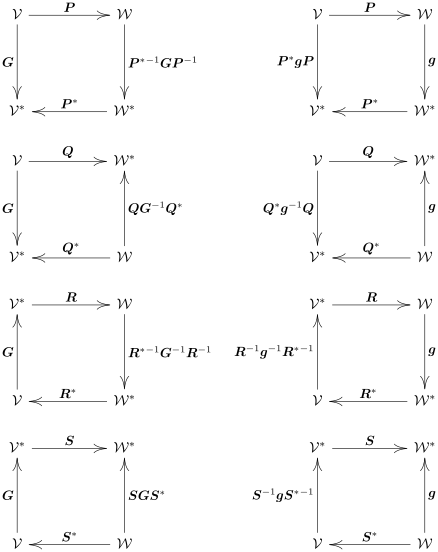
Commutative diagrams involving the linear mappings P,Q,R,S\BP,\BQ,\BR,\BS and their dual P,Q,R,S\BP^\ast,\BQ^\ast,\BR^\ast,\BS^\ast based on the metrics G\BG and g\Bg of V\CV and W\CW.