Entries for 2023
-

-
How to model an AI conversation
A mathematical model for agent conversations, including message trees, internal and external state, integrity constraints, state transitions, and halting.
Introduction
From the user’s perspective, a conversation is a series of interlinked messages, forming a tree. Each message can be seen as a node, and the flow of the conversation is represented by edges connecting these nodes. It is this tree-like structure that gives users a clear and coherent view of the unfolding dialogue.
Take the JSON below as an example. It’s a conversation from ChatGPT, but with a lot of data left out:
Click here to see huge JSON
{
  "title": "Test repetition requested",
  "create_time": 1698438998.854503,
  "update_time": 1698439032.992005,
  "mapping": {
    "52b648d0-c232-494e-a8e1-b7e1a668a8d8": {
      "id": "52b648d0-c232-494e-a8e1-b7e1a668a8d8",
      "message": {
        "id": "52b648d0-c232-494e-a8e1-b7e1a668a8d8",
        "author": { "role": "system", "metadata": {} },
        "content": { "content_type": "text", "parts": [""] }
      },
      "parent": "aaa11385-8b7f-4ff8-bbd2-6dca3ba97332",
      "children": ["aaa2ec55-09f9-4fa4-8345-3e091c396c93"]
    },
    "aaa11385-8b7f-4ff8-bbd2-6dca3ba97332": {
      "id": "aaa11385-8b7f-4ff8-bbd2-6dca3ba97332",
      "children": ["52b648d0-c232-494e-a8e1-b7e1a668a8d8"]
    },
    "aaa2ec55-09f9-4fa4-8345-3e091c396c93": {
      "id": "aaa2ec55-09f9-4fa4-8345-3e091c396c93",
      "message": {
        "id": "aaa2ec55-09f9-4fa4-8345-3e091c396c93",
        "author": { "role": "user", "metadata": {} },
        "content": {
          "content_type": "text",
          "parts": ["Node 1.\nI'm doing a test. Just repeat what I say."]
        }
      },
      "parent": "52b648d0-c232-494e-a8e1-b7e1a668a8d8",
      "children": ["5df2792d-af5b-4a6d-b94e-22ccb4e67cf8"]
    },
    "5df2792d-af5b-4a6d-b94e-22ccb4e67cf8": {
      "id": "5df2792d-af5b-4a6d-b94e-22ccb4e67cf8",
      "message": {
        "id": "5df2792d-af5b-4a6d-b94e-22ccb4e67cf8",
        "author": { "role": "assistant", "metadata": {} },
        "content": { "content_type": "text", "parts": ["Node 1."] }
      },
      "parent": "aaa2ec55-09f9-4fa4-8345-3e091c396c93",
      "children": [
        "aaa231d2-cb1a-4028-a3fb-2799cbe8633e",
        "aaa2ec28-9cc9-4b41-9f63-4dcb413ff1da"
      ]
    },
    "aaa231d2-cb1a-4028-a3fb-2799cbe8633e": {
      "id": "aaa231d2-cb1a-4028-a3fb-2799cbe8633e",
      "message": {
        "id": "aaa231d2-cb1a-4028-a3fb-2799cbe8633e",
        "author": { "role": "user", "metadata": {} },
        "content": {
          "content_type": "text",
          "parts": ["Node 2.\nI'm doing a test. Just repeat what I say."]
        }
      },
      "parent": "5df2792d-af5b-4a6d-b94e-22ccb4e67cf8",
      "children": ["dee00795-4844-45fe-8205-f48302b73463"]
    },
    "dee00795-4844-45fe-8205-f48302b73463": {
      "id": "dee00795-4844-45fe-8205-f48302b73463",
      "message": {
        "id": "dee00795-4844-45fe-8205-f48302b73463",
        "author": { "role": "assistant", "metadata": {} },
        "content": {
          "content_type": "text",
          "parts": ["Node 2.\nI'm doing a test. Just repeat what I say."]
        }
      },
      "parent": "aaa231d2-cb1a-4028-a3fb-2799cbe8633e",
      "children": []
    },
    "aaa2ec28-9cc9-4b41-9f63-4dcb413ff1da": {
      "id": "aaa2ec28-9cc9-4b41-9f63-4dcb413ff1da",
      "message": {
        "id": "aaa2ec28-9cc9-4b41-9f63-4dcb413ff1da",
        "author": { "role": "user", "metadata": {} },
        "content": {
          "content_type": "text",
          "parts": ["Node 3.\nI'm doing a test. Just repeat what I say."]
        }
      },
      "parent": "5df2792d-af5b-4a6d-b94e-22ccb4e67cf8",
      "children": ["848b706b-166e-4ad0-866c-ef5f2cf21f10"]
    },
    "848b706b-166e-4ad0-866c-ef5f2cf21f10": {
      "id": "848b706b-166e-4ad0-866c-ef5f2cf21f10",
      "message": {
        "id": "848b706b-166e-4ad0-866c-ef5f2cf21f10",
        "author": { "role": "assistant", "metadata": {} },
        "create_time": 1698439020.982715,
        "content": { "content_type": "text", "parts": ["Node 3."] }
      },
      "parent": "aaa2ec28-9cc9-4b41-9f63-4dcb413ff1da",
      "children": ["aaa2570f-5d27-4489-a1e3-8db98dc249b6"]
    },
    "aaa2570f-5d27-4489-a1e3-8db98dc249b6": {
      "id": "aaa2570f-5d27-4489-a1e3-8db98dc249b6",
      "message": {
        "id": "aaa2570f-5d27-4489-a1e3-8db98dc249b6",
        "author": { "role": "user", "metadata": {} },
        "create_time": 1698439032.609726,
        "content": {
          "content_type": "text",
          "parts": ["Node 4.\nI'm doing a test. Just repeat what I say."]
        }
      },
      "parent": "848b706b-166e-4ad0-866c-ef5f2cf21f10",
      "children": ["17c26d4b-28a4-49e0-84cf-65752b233a5f"]
    },
    "17c26d4b-28a4-49e0-84cf-65752b233a5f": {
      "id": "17c26d4b-28a4-49e0-84cf-65752b233a5f",
      "message": {
        "id": "17c26d4b-28a4-49e0-84cf-65752b233a5f",
        "author": { "role": "assistant", "metadata": {} },
        "create_time": 1698439032.990924,
        "content": { "content_type": "text", "parts": ["Node 4."] }
      },
      "parent": "aaa2570f-5d27-4489-a1e3-8db98dc249b6",
      "children": []
    }
  },
  "moderation_results": [],
  "current_node": "17c26d4b-28a4-49e0-84cf-65752b233a5f",
  "conversation_id": "5e18bb0e-a8dc-4ebe-89ab-e3746b9782ea"
}
A few things should catch our attention:
- The root node,
aaa11385-8b7f-4ff8-bbd2-6dca3ba97332, does not have a parent. - Each field in the
mappingobject corresponds to a node in the tree. Theparentandchildrenfields point to related nodes by their IDs.
I wrote a script to convert any such saved conversation into a Mermaid diagram:
graph TD
52b648d0-c232-494e-a8e1-b7e1a668a8d8["system: null"]
52b648d0-c232-494e-a8e1-b7e1a668a8d8 --> aaa2ec55-09f9-4fa4-8345-3e091c396c93
style aaa11385-8b7f-4ff8-bbd2-6dca3ba97332 text-align:left
aaa11385-8b7f-4ff8-bbd2-6dca3ba97332["Root Node"]
aaa11385-8b7f-4ff8-bbd2-6dca3ba97332 --> 52b648d0-c232-494e-a8e1-b7e1a668a8d8
aaa2ec55-09f9-4fa4-8345-3e091c396c93["user: Node 1.\nI'm doing a test. Just repeat what I say."]
aaa2ec55-09f9-4fa4-8345-3e091c396c93 --> 5df2792d-af5b-4a6d-b94e-22ccb4e67cf8
5df2792d-af5b-4a6d-b94e-22ccb4e67cf8["assistant: Node 1."]
5df2792d-af5b-4a6d-b94e-22ccb4e67cf8 --> aaa231d2-cb1a-4028-a3fb-2799cbe8633e
5df2792d-af5b-4a6d-b94e-22ccb4e67cf8 --> aaa2ec28-9cc9-4b41-9f63-4dcb413ff1da
aaa231d2-cb1a-4028-a3fb-2799cbe8633e["user: Node 2.\nI'm doing a test. Just repeat what I say."]
aaa231d2-cb1a-4028-a3fb-2799cbe8633e --> dee00795-4844-45fe-8205-f48302b73463
dee00795-4844-45fe-8205-f48302b73463["assistant: Node 2.\nI'm doing a test. Just repeat what I say."]
aaa2ec28-9cc9-4b41-9f63-4dcb413ff1da["user: Node 3.\nI'm doing a test. Just repeat what I say."]
aaa2ec28-9cc9-4b41-9f63-4dcb413ff1da --> 848b706b-166e-4ad0-866c-ef5f2cf21f10
848b706b-166e-4ad0-866c-ef5f2cf21f10["assistant: Node 3."]
848b706b-166e-4ad0-866c-ef5f2cf21f10 --> aaa2570f-5d27-4489-a1e3-8db98dc249b6
aaa2570f-5d27-4489-a1e3-8db98dc249b6["user: Node 4.\nI'm doing a test. Just repeat what I say."]
aaa2570f-5d27-4489-a1e3-8db98dc249b6 --> 17c26d4b-28a4-49e0-84cf-65752b233a5f
17c26d4b-28a4-49e0-84cf-65752b233a5f["assistant: Node 4."]
The conversation tree
The conversation tree can be modeled using graph theory. It is a graph where nodes represent messages and directed edges represent the flow of the conversation.
Let’s define the conversation tree:
Definition
A conversation tree is defined as where:
- is a set of nodes, where each node represents a message.
- is a set of directed edges, where each edge represents a response or a follow-up to a message.
Nodes
Each node can be represented by:
where:
- is a unique identifier for the message.
- indicates the sender of the message.
- is the text of the message.
- is the time the message was sent.
- The tuple can include additional metadata.
Edges
Each directed edge is an ordered pair where:
- is the parent message.
- is the child message or the response to .
Root
There is a unique node such that no edges in point to . This node is called the root of the tree and represents the starting point of the conversation.
Properties
- Acyclic: The graph does not contain any cycles. This ensures that the conversation has a clear flow without any looping back.
- Directed: The edges have a direction, indicating the flow of the conversation.
- Tree structure: There is exactly one path from the root to each node. This gives the conversation a hierarchical structure.
Functions
- Parent function: assigns each non-root node its parent .
- Children function: assigns each node its set of child nodes .
This mathematical formulation captures the essence of the conversation tree as presented in the JSON structure. By using graph theory, we can further analyze properties of the conversation, such as its depth, branching factor, and other relevant metrics.
Internal vs external state
The conversation tree only represents the user-facing part, or the external state, of the conversation. We call information that is part of the conversation but hidden from the user the internal state. For example, a hidden system prompt is part of the internal state.
Given the new definitions and constraints, we can refine the mathematical formulation to account for both the external and internal states of the conversation. Here’s an updated model:
Conversation state
The conversation state at time is defined as:
where:
- represents the external state at time .
- represents the internal state at time .
Here, represents the entire state at any given time. We denote the set of all possible states by .
External state
The external state at time , , is defined as an abstract representation of the system’s observable output, represented as a set or vector. This could be the current view of the conversation, the messages exchanged, or any other output that is visible to the user.
Integrity of the external state
There is one very important constraint for how the external state should evolve. Anything that the user has already seen should not change. This means that the external state can only increase over time, and not decrease. Formally, this can be expressed as:
The external state (observable output) at time is a subset of the external state at time , ensuring that the observable output can only be appended with new information or remain the same over time, but not altered or removed.
This constraint ensures that the integrity of the external conversation history is always preserved, while the internal state can change flexibly. In other words,
Anything about the conversation can change except what the system has already shown to the user.
This is one of the most important parts of the formulation.
Why use an abstract model?
At a basic level, this post describes a chatbot history that can track alternative user and assistant responses. Future systems can look different from conversations serialized as JSON objects. An abstract model removes infrastructure assumptions and keeps the one necessary rule: the integrity principle.
Integrity Principle
The record of actions that an agent has taken in the past cannot be changed.
I believe that the “why” is self-evident, without going into philosophy. As for the case of conversations, I represent the external state as a tree:
External state as a tree
The external state at time , , is defined as a tree:
where:
- is a set of nodes at time .
- is a set of directed edges at time .
As for the integrity requirement, only new nodes can be appended at any existing node, including the root node. The part of the tree from the previous step should remain the same:
- : The set of nodes can only increase or remain the same over time.
- : The set of edges can only increase or remain the same over time.
- Nodes and edges from previous times remain unchanged, ensuring that the conversation history is preserved.
As an example, consider the following evolution of state of a user’s interaction:
flowchart TD
    0{V0} --> 1((V1))
    1 -.-> 2(V2)
    2 --> 3((V3))
    3 -.-> 4(V4)
    0 --> 5((V5))
    5 -.-> 6(V6)
    2 --> 7((V7))
    7 -.-> 8(V8)
The conversation evolved like this:
- The user started with an empty state , that is consisting only of the root node and no edges. Think of this like landing on the chat page for the first time. (The root node is not something that the user can visibly see, but it is sent by the API.)
- Then, they sent a message, which created a new node .
- The system did some processing, called the LLM, and responded with a message, resulting in a new node .
- The user sent another message, which resulted in a new node , and the system responded with a message, resulting in a new node .
- The user then went to the beginning of the conversation and edited their first message, resulting in the creation of a branch. The original message is preserved, and a new node is created.
- The system processes the edited message, which results in a new node , serving as a response to the edited initial message .
- Meanwhile, the user also revisits their second message (originally resulting in ) and edits it, creating another branch in the conversation with a new node .
- The system processes this second edited message, leading to a new system response and the creation of node .
The circular nodes represent user messages, and the rectangular nodes represent system messages. The full edges represent the edits to the state by the user, and the dashed edges represent the edits to the state by the assistant.
As an exercise, let’s write down and draw the external state at each step. We already described the initial state above, with only the root node:
flowchart TD
    0{V0}
The rest follow as:
flowchart TD 0{V0} --> 1((V1))flowchart TD 0{V0} --> 1((V1)) 1 -.-> 2(V2)flowchart TD 0{V0} --> 1((V1)) 1 -.-> 2(V2) 2 --> 3((V3))flowchart TD 0{V0} --> 1((V1)) 1 -.-> 2(V2) 2 --> 3((V3)) 3 -.-> 4(V4)flowchart TD 0{V0} --> 1((V1)) 1 -.-> 2(V2) 2 --> 3((V3)) 3 -.-> 4(V4) 0 --> 5((V5))flowchart TD 0{V0} --> 1((V1)) 1 -.-> 2(V2) 2 --> 3((V3)) 3 -.-> 4(V4) 0 --> 5((V5)) 5 -.-> 6(V6)flowchart TD 0{V0} --> 1((V1)) 1 -.-> 2(V2) 2 --> 3((V3)) 3 -.-> 4(V4) 0 --> 5((V5)) 5 -.-> 6(V6) 2 --> 7((V7))flowchart TD 0{V0} --> 1((V1)) 1 -.-> 2(V2) 2 --> 3((V3)) 3 -.-> 4(V4) 0 --> 5((V5)) 5 -.-> 6(V6) 2 --> 7((V7)) 7 -.-> 8(V8)In each step, the external state is expanded to include new nodes and edges, adhering to the principle of “Integrity of the External State,” where previous nodes and edges remain unchanged.
An implementation should:
- Keep track of the external state reliably.
- Switch between branches efficiently.
- Limit the amount of data stored and sent to the client.
- Handle multiple users and conversations at scale.
- Handle conversations that can contain hundreds of messages.
Internal state
Similar to the external state, we represent the internal state at time , , as a set or vector capturing the system’s internal parameters, context, or any other hidden variables. It evolves over time based on system logic, user interactions, prompt engineering, tool calls and potentially other factors.
where:
- represents hidden variables or parameters at time .
–>
We don’t define a specific constraint on how should evolve. It can change based on the system’s internal machinery and requirements.
State transition
A transition function defines how a system moves from one state to another based on its inputs. Here, it defines how the visible conversation tree and internal state evolve over time.
Given , the next conversation state is a function of both the current external and internal states:
The transition function must obey the constraints we defined earlier:
- The external state transitions by only appending nodes and edges, and not modifying previous nodes or edges.
- The internal state transitions according to the system’s requirements and logic.
Here, is a general transition function that does not distinguish between changes made by the user and changes made by the assistant. The next section makes that distinction.
User and assistant transitions
The system combines a user and an assistant. The user provides an input, and the assistant works on it until a halting condition is fulfilled. For example, the assistant can stop after it completes the user’s task.
To this end, we introduce a user transition function and an assistant transition function .
The user transition function formalizes changes that the user can make to the conversation state, such as sending or editing a message. An edit creates a new branch in the conversation tree. By definition, the user cannot see or modify the internal state, so the function only operates on the external state:
The assistant can modify both the external and internal state:
For example, the assistant could query a knowledge base, save the results to the internal state, generate a response with an LLM, and send a message to the user. The assistant transition function would then update both the external and internal state.
The user and assistant transition the state in rounds. In this model, the user can only send a message when the assistant is done processing the previous message. As a mental model, you can think that there is a human behind the user function , and there is something resembling a Turing machine behind the assistant function , that does arbitrary computation on the state until it decides to stop. Whether the assistant can stop is formalized by the halting condition :
For example, at the end of each state transition, the assistant could feed the LLM its entire output in the current round and ask
Is the user’s request fulfilled?
If the answer is yes, the halting condition is fulfilled and the assistant stops. If the answer is no, the assistant continues to work on the user’s request. One can also imagine that the assistant should stop after a maximum number of steps, preventing the assistant from going into an infinite loop.
We can now put all of our definitions together to define the main transition function :
Together with the integrity constraint, this box summarizes how the conversation state evolves over time. For example,
call_assistantcan be a recursive function whose input is the current state and whose output is the first state that meets the halting condition:def call_assistant(state): """ Assistant transitions as a recursive function """ new_state = delta(state) if halting_condition(new_state): return new_state else: return call_assistant(new_state)At the end of each round, this function checks whether the halting condition is fulfilled. If it is not, the function calls itself again with the next state.
We could alternatively use a while loop:
def call_assistant(state): """ Assistant transitions as a while loop """ while True: new_state = delta(state) if halting_condition(new_state): return new_state state = new_state - The root node,
-
“the QIPS Exchange -- the marketplace where processing power was bought and sold. The connection to JSN had passed through the Exchange, transparently; her terminal was programmed to bid at the market rate automatically, up to a certain ceiling.” - Permutation City
-
-
Had lots of fun shipping this feature ✌️
-
Cognitive Biases Ranked by Popularity
If you have spent some time on rationalist forums, you might have come across images that try to visualize cognitive biases that humans are prone to:
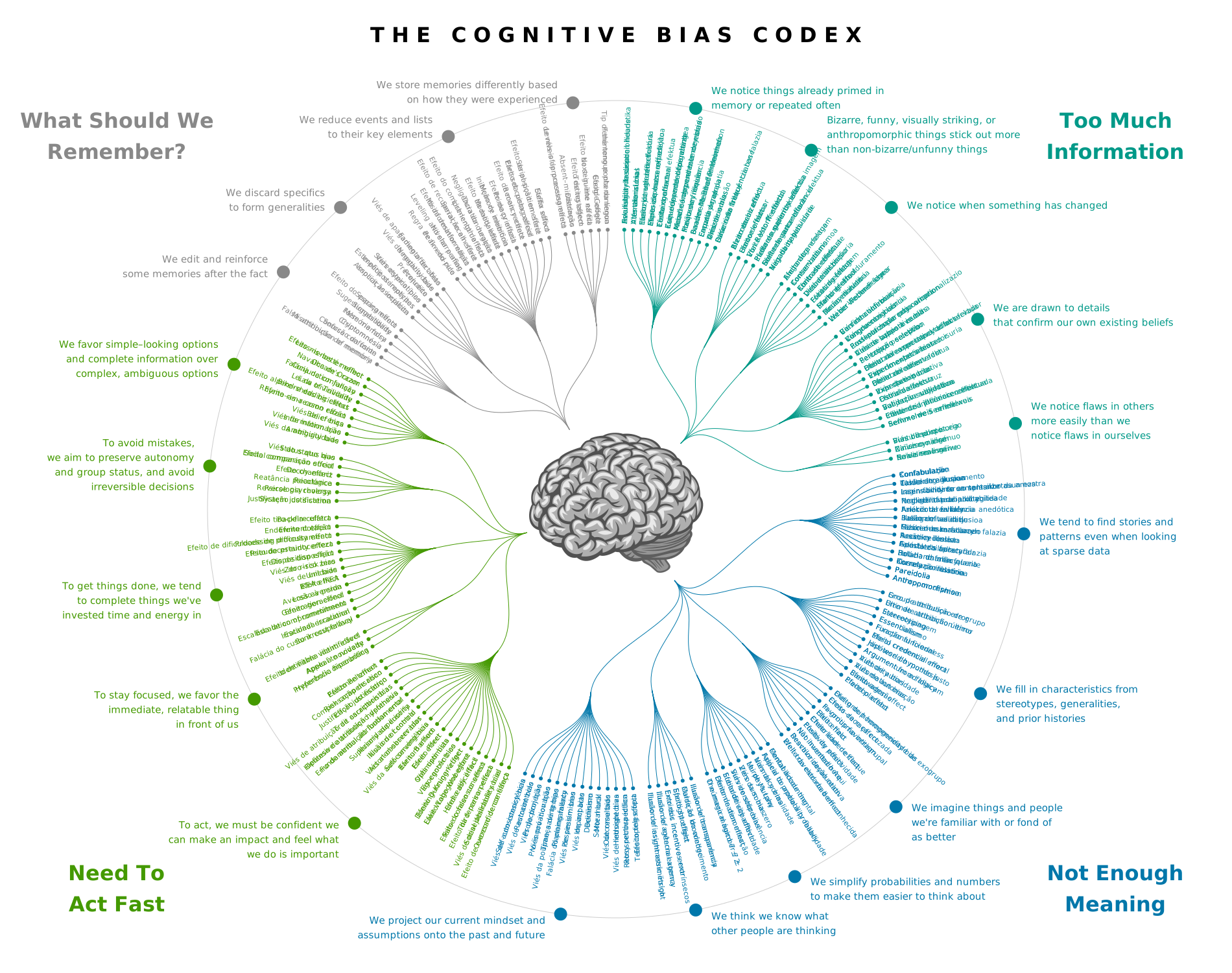
This specific one has been created by John Manoogian III and Buster Benson, who compiled the list of biases from Wikipedia.
It is a great way to get a sense of the sheer number of biases that exist, but it doesn’t tell you much about how much of the popular mindshare each bias has. All the biases having the same size implies that they are all equally important, but that is obviously not the case. Arguably, for someone who has just started to learn about cognitive biases, confirmation bias should be more important than, say, the Peltzmann effect.
To measure and visualize the popularity of each bias, I…
- ran a Google search with the format
"<insert cognitive bias here>" cognitive biasusing a SERP API, - got the number of search results for each term,
- created a wordcloud using the wordcloud Python package,
- used logarithms of the search count for better scaling,
- used the same colors as the Cognitive Bias Codex for consistency,
- used a shape mask of a brain to make it look cool.
Here is the result:
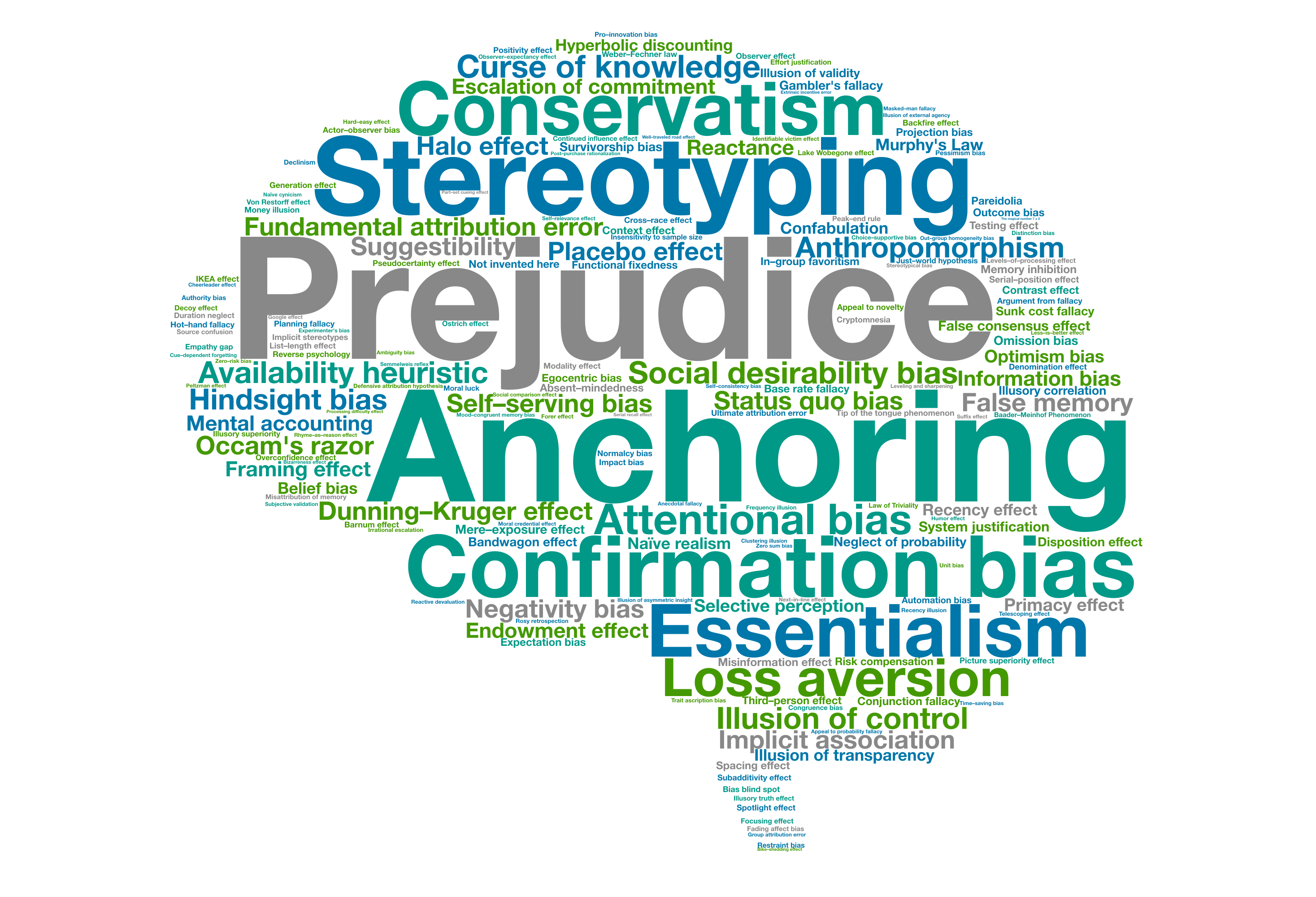
The bigger the font, the more Google search results there are for that bias, the assumption being Google search results are a good measure of popularity.
Why should you care about the popularity of biases? The more popular or common a bias is, the more likely you are to be affected by it. So it makes sense to study them in decreasing order of popularity, to maximize the benefit to your own thinking. However, this is all statistics—you could still be impacted more by a bias that is smaller in the wordcloud. For example, there was a time when I was very prone to the sunk cost fallacy, even though it doesn’t show up so large in the wordcloud.
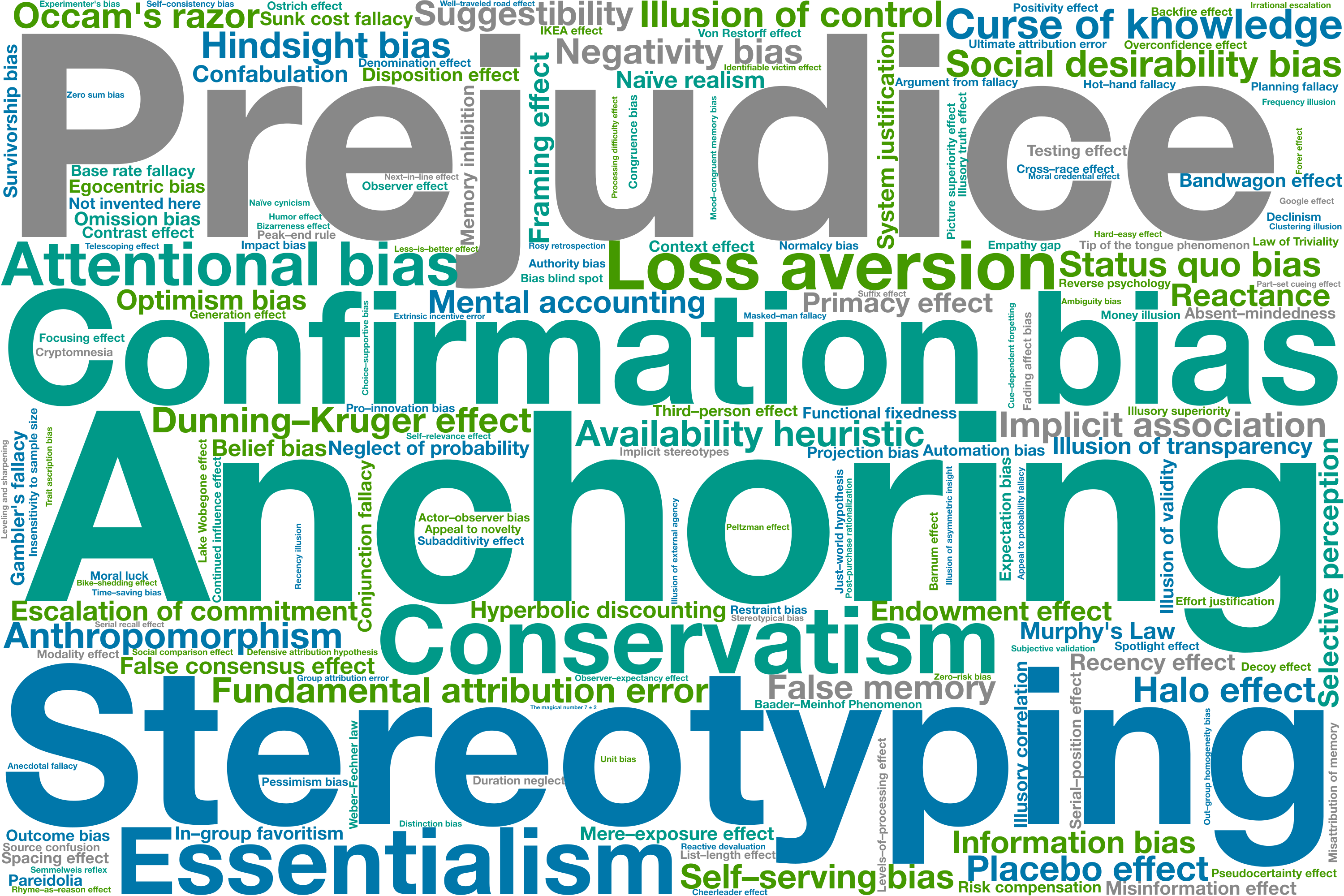
Below is a version of the image without the shape mask:
Below are the top 10 biases ranked by Google search result count:
Cognitive bias Search result count Prejudice 8,560,000 Anchoring 1,100,000 Stereotyping 1,080,000 Confirmation bias 992,000 Conservatism 610,000 Essentialism 436,000 Loss aversion 426,000 Attentional bias 374,000 Curse of knowledge 373,000 Social desirability bias 319,000 Click here to see the search result counts for each 188 biases included above.
I have also computed the average search result count for each category of biases, by dividing the total search result count for each category by the number of biases in that category:
Category Average count We discard specifics to form generalities 1,494,378 We notice when something has changed 237,141 We fill in characteristics from stereotypes, generalities, and prior histories 160,170 We are drawn to details that confirm our own existing beliefs 93,350 We think we know what other people are thinking 81,555 To act, we must be confident we can make an impact and feel what we do is important 72,435 We notice things already primed in memory or repeated often 70,835 To get things done, we tend to complete things we’ve invested time and energy in 65,822 To avoid mistakes, we aim to preserve autonomy and group status, and avoid irreversible decisions 65,750 We edit and reinforce some memories after the fact 59,503 We favor simple-looking options and complete information over complex, ambiguous options 52,491 We tend to find stories and patterns even when looking at sparse data 46,375 To stay focused, we favor the immediate, relatable thing in front of us 37,940 Bizarre, funny, visually striking, or anthropomorphic things stick out more than non-bizarre/unfunny things 37,081 We imagine things and people we’re familiar with or fond of as better 34,379 We simplify probabilities and numbers to make them easier to think about 33,881 We notice flaws in others more easily than we notice flaws in ourselves 31,390 We project our current mindset and assumptions onto the past and future 29,418 We reduce events and lists to their key elements 27,638 We store memories differently based on how they were experienced 20,440 Notice that the top few biases such as prejudice and anchoring highly skew the ranking.
Similarly, I have computed the average search result count for each top category of biases:
Top category Average count What Should We Remember? 316,297 Too Much Information 101,842 Need To Act Fast 64,568 Not Enough Meaning 64,134 You can see the code I used to create the figure here.
I will not try to reason as to why some biases are more popular than others, and instead leave that for another post.
- ran a Google search with the format
-
-
I've just published *Code-Driven Videos*, my long term vision behind Manim Voiceover plugin. I will try to summarize it on this thread 👇🧵 cc @manim_community osolmaz.github.io/blog/code-driv…
-
Code-Driven Videos
tl;dr I created Manim Voiceover, a plugin for the Python math animation library Manim that lets you add voiceovers to your Manim videos directly in Python, with both AI voices or actual recordings.
This makes it possible to create “fully code-driven” educational videos in pure Python. Videos can be developed like software, taking advantage of version controlled, git-based workflows (i.e. no more Final.final.final.mp4 :),
It also makes it possible to use AI to automate all sorts of things. For example, I have created a pipeline for translating videos into other languages automatically with i18n (gettext) and machine translation (DeepL).
Follow my Twitter to get updates on Manim Voiceover.
A little background
For those who are not familiar, Manim is a Python library that lets you create animations programmatically, created by Grant Sanderson, a.k.a. 3blue1brown. His visual explainers are highly acclaimed and breathtakingly good (to see an example, click here for his introduction to neural networks).
Manim was originally built for animating math, but you can already see it being used in other domains such as physics, chemistry, computer science, and so on.
Creating any video is a very time-consuming process. Creating an explainer that needs to be mathematically exact is even more so, because the visuals often need to be precise to convey knowledge efficiently. That is why Manim was created: to automate the animation process. It turns out programming mathematical structures is easier than trying to animate them in a video editor.
However, this results in a workflow that is part spent in the text editor (writing Python code), and part in the video editor (editing the final video), with a lot of back and forth in between. The main reason is that the animation needs to be synced with voiceovers, which are recorded separately.
In this post, I will try to demonstrate how we can take this even further by making voiceovers a part of the code itself with Manim Voiceover, and why this is so powerful.
The traditional workflow
Creating a video with Manim is very tedious. The steps involved are usually as follows:
- Plan: come up with a script and a screenplay.
- Record: Record the voiceover with a microphone.
- Animate: Write the Python code for each scene, that will generate the animation videos.
- Edit: Overlay and synchronize the voiceover and animations in a video editor, such as Adobe Premiere.
The workflow is often not linear. The average video requires you to rewrite, re-record, re-animate and re-sync multiple scenes:

The less experience you have making videos, the more takes you will need. Creating such an explainer has a very steep learning curve. It can take up to 1 month for a beginner to create their first few minutes of video.
Enter Manim Voiceover
I am a developer by trade, and when I first tried to create a video with the traditional workflow, I found it harder than it should be. We developers are spoiled, because we get to enjoy automating our work. Imagine that you had to manually compile your code using a hex editor every time you made a change. That is what it felt like to create a video using a video editor. The smallest change in the script meant that I had to re-animate, re-record and re-sync parts of the video, the main culprit being the voiceover.
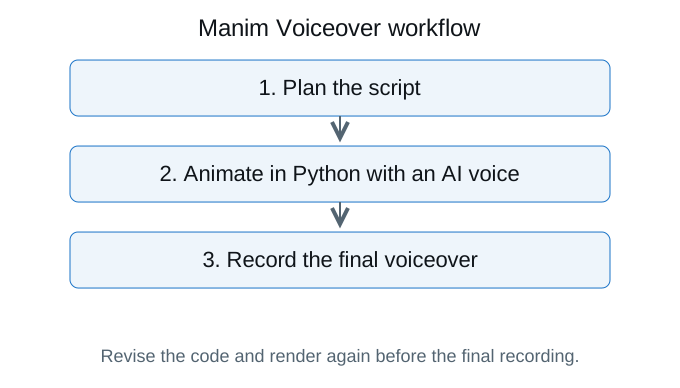
To overcome this, I thought of a simple idea: Create an API that lets one to add voiceovers directly in Python. Manim Voiceover does exactly that and provides a comprehensive framework for automating voiceovers. Once the entire production can be done in Python, editing in the video editor becomes mostly unnecessary. The workflow becomes:
- Plan: Same as before.
- Animate: Develop the video with an AI-generated voiceover, all in Python.
- Record: When the final revision is ready, record the actual voiceover with Manim Voiceover’s recorder utility. The audio is transcribed with timestamps and inserted at the right times automatically.
A little demo—see how a video would look like at the end of step (2):
And watch below to see how it would look like at the end of step (3), with my own voice:
I explain why this is so powerful below:
Zero-cost revisions
In the previous method, making modifications to the script has a cost, because you need to re-record the voiceover and readjust the scenes in the video editor. Here, making modifications is as easy as renaming a variable, since the AI voiceover is generated from code automatically. This saves a lot of time in the production process:
This lets videos created with Manim to be “fully code-driven” and take advantage of open source, collaborative, git-based workflows. No manual video editing needed, and no need to pay for overpriced video editing software:

(Or at least drastically reduced need for them)
Increased production speed
From personal experience and talking to others who have used it, Manim Voiceover increases production speed by a factor of at least 2x, compared to manual recording and editing.
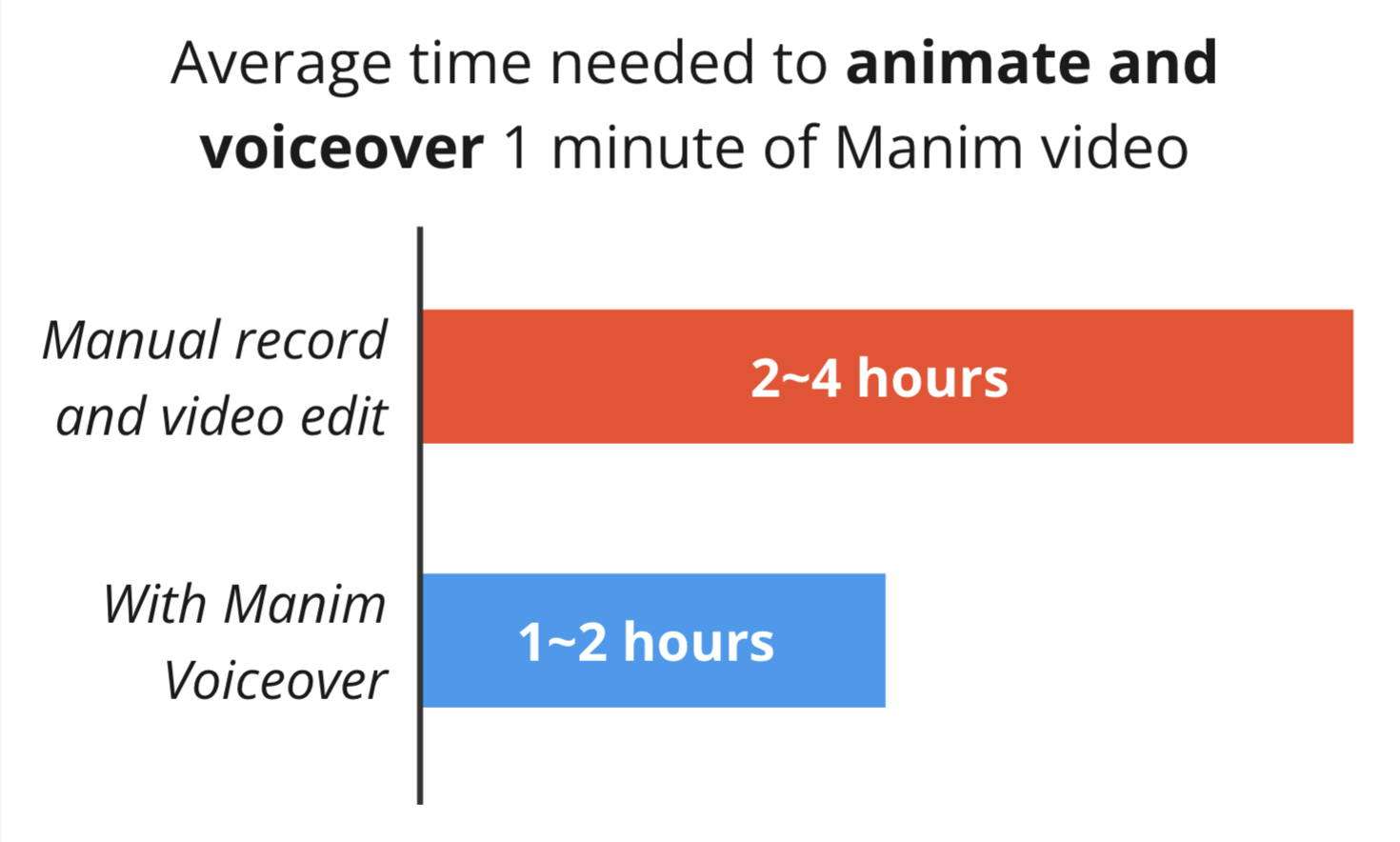
Note: The current major bottlenecks are developing the scene itself and waiting for the render. Regarding render speed: Manim CE’s Cairo renderer is much slower then ManimGL’s OpenGL renderer. Manim Voiceover currently only supports Manim CE, but it is on my roadmap to add support ManimGL.
The API in a nutshell
This all sounds great, but how does it look like in practice? Let’s take a look at the API. Here is a “Hello World” example for Manim, drawing a circle:
from manim import *

class Example(Scene):
    def construct(self):
        circle = Circle()
        self.play(Create(circle))
Here is the same scene, with a voiceover that uses Google Translate’s free text-to-speech service:
from manim import *
from manim_voiceover import VoiceoverScene
from manim_voiceover.services.gtts import GTTSService

class VoiceoverExample(VoiceoverScene):
    def construct(self):
        self.set_speech_service(GTTSService(lang="en"))

        circle = Circle()
        with self.voiceover(text="This circle is drawn as I speak."):
            self.play(Create(circle))
Notice the
withstatement. You can chain such blocks back to back, and Manim will vocalize them in sequence:with self.voiceover(text="This circle is drawn as I speak."): self.play(Create(circle)) with self.voiceover(text="Let's shift it to the left 2 units."): self.play(circle.animate.shift(2 * LEFT))The code for videos made with Manim Voiceover generally looks cleaner, since it is compartmentalized into blocks with voiceovers acting as annotations on top of each block.
See how this is rendered:
Record
To record an actual voiceover, you simply change a single line of code:
# self.set_speech_service(GTTSService(lang="en")) # Comment this out
self.set_speech_service(RecorderService())        # Add this line
Currently, rendering with
RecorderServicestarts up a voice recorder implemented as a command line utility. The recorder prompts you to record each voiceover in the scene one by one and inserts audio at appropriate times. In the future, a web app could make this process even more seamless.Check out the documentation for more examples and the API specification.
Auto-translating videos
Having a machine readable source for voiceovers unlocks another superpower: automatic translation. Manim Voiceover can automatically translate your videos to any language, and even generate subtitles in that language. This will let educational content creators reach a much wider audience.
Here is an example of the demo translated to Turkish and rendered with my own voice:
To create this video, I followed these steps:
- I wrapped transtable strings in my demo inside
_()per gettext convention. For example, I changedtext="Hey Manim Community!"totext=_("Hey Manim Community!"). - I ran
manim_translate blog-translation-demo.py -s en -t tr -d blog-translation-demo, which created thelocalefolder, called DeepL’s API to translate the strings, and saved them underlocale/tr/LC_MESSAGES/blog-translation-demo.po.
- Here,
-sstands for source language, -tstands for target language,- and
-dstands for the gettext domain.
- I edited the
.pofile manually, because the translation was still a bit off. - I ran
manim_render_translation blog-translation-demo.py -s BlogTranslationDemo -d blog-translation-demo -l tr -qh, which rendered the final video.
Check out the translation page in the docs for more details. You can also find the source code for this demo here.
Here is a Japanese translation, created the same way but with an AI voiceover:
Note that I have very little knowledge of Japanese so that the translation might be off, but I was still able to create it with services that are freely available online. This is to foreshadow how communities could create and translate educational videos in the future:
- Video is created using Manim/Manim Voiceover and is open-sourced.
- The repo is connected to a CI/CD service that tracks the latest changes, re-renders and deploys the video to a permalink.
- When a translation in a language is requested, said service automatically generates it using AI translation and voiceover.
- The community can then review the translation and voiceover, make changes if necessary, and record a human voiceover if they want to.
- All the different versions and translations of the video are seamlessly deployed, similar to how ReadTheDocs deploys software documentation.
That is the main idea of my next project, GitMovie. If this excites you, leave your email address on the form on the website to get notified when it launches.
Conclusion
While using Manim Voiceover might seem tedious to some who are already using Manim with a video editor, I guarantee that it is overall more convenient than using a video editor when it comes to adding voiceovers to scenes. Feel free to create an issue if you have a use case that is currently not covered by Manim Voiceover.
What is even more interesting, Manim Voiceover can provide AI models such as GPT-4 with a convenient way to generate mathematically precise videos. Khan Academy has recently debuted a private release of Khanmigo, their GPT-4 based AI teacher. Imagine that Khanmigo could create a 3blue1brown-level explainer in a matter of minutes, for any question you ask! (I already tried to make GPT-4 output Manim code, but it is not quite there yet.)
To see why this is powerful, check out my video rendering of Euclid’s Elements using Manim Voiceover (part 1):
This video itself is pedagogically not very effective because books do not necessarily translate into good video scripts. But it serves as preparation for the point that I wanted to make with this post:
Having a machine-readable source and being able to program voiceovers allowed me to generate over 10 hours of video in less than a few days. In a few years, AI models will make such approaches 1000 times easier, faster and cheaper for everyone.
Imagine being able to auto-generate the “perfect explainer” for every article on Wikipedia, every paper on arXiv, every technical specification that would otherwise be too dense. In every language, available instantly around the globe. Universal knowledge, accessible by anyone who is willing to learn. Thanks to 3blue1brown, Manim and similar open source projects, all of this will be just a click away!
-
You can now translate voiceovers in your Manim scenes into other languages using @DeepLcom Blog post with examples coming soon @manim_community voiceover.manim.community/en/stable/tran…
-
Revamp complete docs.textcortex.com @TextCortex