---
title: "Bitcoin's Inflation"
date: 2019-02-09
canonical: https://solmaz.io/2019/02/09/inflation-curvature-bitcoin-supply/
license: CC BY 4.0 (https://creativecommons.org/licenses/by/4.0/)
---
New bitcoins are minted with every new block in the Bitcoin blockchain, called "block
rewards", in order to incentivize people to mine and increase the security of the network. This
inflates Bitcoin's supply in a predictable manner. The inflation rate halves every
4 years, decreasing geometrically.
There have been some confusion of the terminology, like people calling Bitcoin
deflationary. Bitcoin is in fact not deflationary---that implies a negative
inflation rate. Bitcoin rather has negative **inflation curvature**: Bitcoin's
inflation rate decreases monotonically.
An analogy from elementary physics should clear things up: Speaking strictly in
terms of monetary inflation,
- *displacement* is analogous to *inflation/deflation*, as in total money
minted/burned, without considering a time period. Dimensions: $[M]$.
- *Velocity* is analogous to *inflation rate*, which defines total money minted/burned
in a given period. Dimensions: $[M/T]$.
- *Acceleration* is analogous to *inflation curvature*, which defines the total
change in inflation rate in a given period. Dimensions: $[M/T^2]$.
Given a supply function $S$ as a function of time, block height, or any variable
signifying progress,
- inflation is a positive change in supply, $\Delta S > 0$, and deflation, $\Delta S < 0$.
- Inflation rate is the first derivative of supply, $S'$.
- Inflation curvature is the second derivative of supply, $S''$.
In Bitcoin, we have the supply as a function of block height:
$S:\mathbb{Z}_{\geq 0} \to \mathbb{R}\_+$.
But the function itself is defined by the arithmetic[^1] initial value problem
$$
S'(h) = \alpha^{\lfloor h/\beta\rfloor} R_0
,\quad
S(0) = 0
\tag{1}
$$
where $R_0$ is the initial inflation rate, $\alpha$ is the rate by which the
inflation rate will decrease, $\beta$ is the milestone number of blocks at
which the decrease will take place, and $\lfloor \cdot \rfloor$ is the floor
function. In Bitcoin, we have $R_0 = 50\text{ BTC}$,
$\alpha=1/2$ and $\beta=210,000\text{ blocks}$. Here is what it looks like:
Bitcoin inflation rate versus block height.
We can directly compute inflation curvature:
$$
S''(h) =
\begin{cases}
\frac{\ln(\alpha)}{\beta} \alpha^{h/\beta} & \text{if}\quad
h\ \mathrm{mod}\ \beta = 0 \quad\text{and}\quad h > 0\\
0 & \text{otherwise}.
\end{cases}
$$
$S''$ is nonzero only when $h$ is a multiple of $\beta$. For $0 < \alpha < 1$,
$S''$ is either zero or negative, which is the case for Bitcoin.
Finally, we can come up with a closed-form $S$ by solving the initial value
problem (1):
$$
\begin{aligned}
S(h) &= \sum_{i=0}^{\lfloor h/\beta\rfloor -1} \alpha^{i} \beta R_0
+ \alpha^{\lfloor h/\beta\rfloor} (h\ \mathrm{mod}\ \beta) R_0 \\
&= R_0 \left(\beta\frac{1-\alpha^{\lfloor h/\beta\rfloor}}{1-\alpha}
+\alpha^{\lfloor h/\beta\rfloor} (h\ \mathrm{mod}\ \beta) \right)
\end{aligned}
$$
Here is what the supply function looks like for Bitcoin:
Bitcoin supply versus block height.
And the maximum number of Bitcoins to ever exist are calculated by taking the
limit
$$
\lim_{h\to\infty} S(h)
= \sum_{i=0}^{\infty} \alpha^{i} \beta R_0
= \frac{\beta R_0}{1-\alpha}
= 21,000,000\text{ BTC}.
$$
# Summary
The concept of inflation curvature was introduced. The confusion regarding
Bitcoin's inflation mechanism was cleared with an analogy. The IVP defining
Bitcoin's supply was introduced and solved to get a closed-form
expression. Inflation curvature for Bitcoin was derived.
The maximum number of Bitcoins to ever exist was derived and computed.
[^1]: Because $S$ is defined over positive integers.
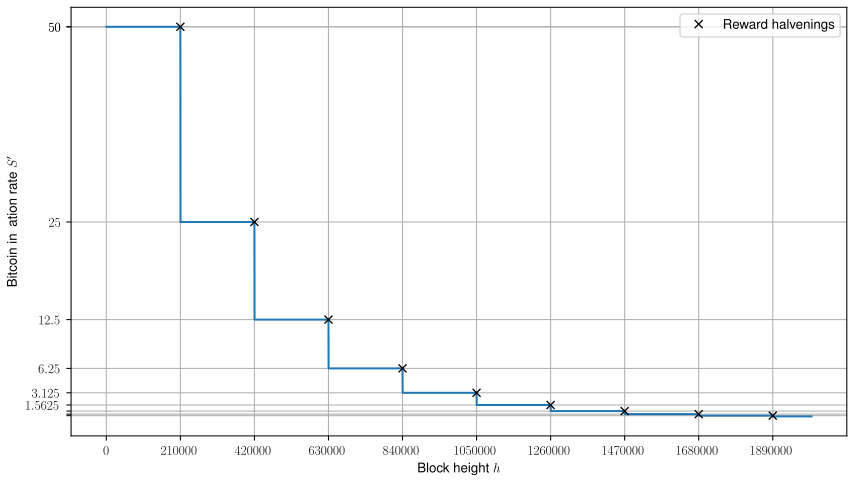 Bitcoin inflation rate versus block height.
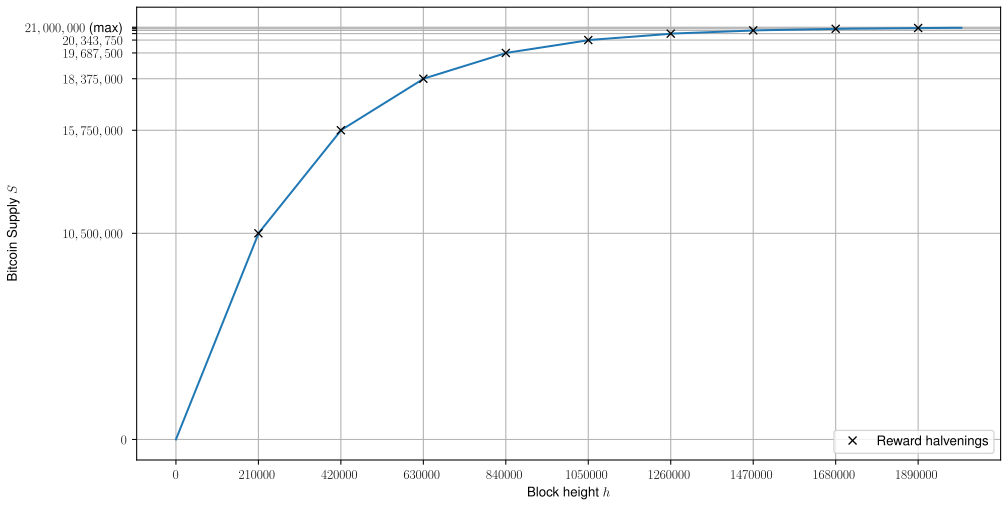 Bitcoin supply versus block height.